June 29, 2026 · EN
Why the economics of disasters should start in the Caribbean
We are told two things about disasters. That after the shock, the economy eventually bounces back. And that a small island is too particular a case to draw general lessons from. In this post, I want to show you that both of these received ideas are wrong, and that the Caribbean is precisely what makes that clear.
A few months after a major hurricane, attention fades. The emergency teams have gone, the main roads have reopened, the images of torn-off roofs have left our screens. For many, that is the sign that life is returning to normal. And yet, if you live in the Caribbean, you know that something never quite returns to where it started. Shops never reopened. Families left the neighbourhood. The price of certain goods, as you probably noticed at the supermarket in the weeks that followed, stayed higher than before. Reconstruction did take place. The real recovery, the one that brings the economy back to where it was, is still waiting.
This intuition, shared by almost everyone in our territories, is precisely what economic theory long struggled to see. And it is why I am convinced of one thing: our islands are not a marginal case in the economics of disasters. They should be its starting point. Here is why.
The reassuring story: the disaster as a parenthesis
Let’s start with the story usually told. A disaster destroys part of a country’s capital: factories, roads, homes, equipment. That destruction makes the remaining capital scarcer, and therefore more profitable to rebuild. Investment flows in, reconstruction keeps the economy turning and creates jobs, and the economy gradually returns to the path it was on before the shock. Economists have a word for this return to normal: convergence. In this view, a disaster is only a parenthesis: painful, but one that the ordinary workings of the market eventually close.
It is this same logic that feeds the seductive idea of “building back better”: since you replace old capital with new, the economy might even come out stronger. It is coherent, it is elegant. Yet it fits rather poorly with what the most exposed economies actually live through.
But the data tell a different story
When you look at real trajectories, the promised rebound often fails to materialise. The most striking study on this point is by Hsiang and Jina (2014), who reconstructed every country’s exposure to the full set of tropical cyclones between 1950 and 2008, some 6,700 storms. Their finding is unambiguous. The data reject the idea that disasters stimulate growth, as well as the idea that the initial losses later heal on their own. On the contrary, national income falls away from its prior trend and does not return to it within the twenty years that follow. To give a sense of scale, a particularly violent cyclone (among the most intense 10%) lowers income per capita by 7.4% two decades later, the equivalent of 3.7 years of development wiped out (the income loss amounts to nearly four years of growth at the country’s usual pace). Reconstruction, then, is not recovery: you can put the walls back up without ever returning to the previous level of wealth.
In fairness, the literature has not always been unanimous. Older cross-country studies, such as Skidmore and Toya (2002), even found that climatic disasters could be associated with stronger long-run growth, through human capital accumulation and the modernisation of the productive base, whereas geological disasters tended to drag growth down instead. So the debate exists, and the whole challenge is to understand what separates an economy that recovers from one that falls behind. But the more recent work, which identifies the causal effect more cleanly, leans clearly towards the persistence of losses. And one regularity stands out: the smaller, more exposed and more constrained an economy is, the less the automatic-rebound scenario holds. Which brings us to our islands.
Why islands don’t bounce back the way the textbook would have it
Island economies accumulate a set of structural features that work against them. A small size that rules out economies of scale (the drop in unit costs that comes with producing in large volumes). A heavy dependence on imports, especially for strategic goods such as food and energy. High logistics costs. A narrow productive specialisation, often centred on a few sectors such as tourism. Limited fiscal room. This is no mere impression: as early as the mid-1990s, the economist Lino Briguglio (1995) turned it into an economic vulnerability index, since updated (Briguglio and Galea, 2003), showing that small island developing states form the group most structurally exposed to forces beyond their control, and that their GDP per capita often masks this fragility.
If we believe the textbook, destroyed capital attracts the investment needed to rebuild it. But that rebound depends on a financing capacity these economies do not always have, and the adjustment then runs largely through public finances. On a panel of Caribbean countries observed over more than three decades, Ouattara and Strobl (2013) show that after a hurricane, public spending rises sharply with no matching rise in revenue, and that governments bridge the gap through short-term deficit financing. With each episode, the fiscal room narrows a little further.
The detail the models forget: the next shock
There is a point that standard theory almost systematically neglects, and that changes everything. It treats each disaster as an isolated event on an otherwise quiet trajectory. A shock, then calm, the time to recover.
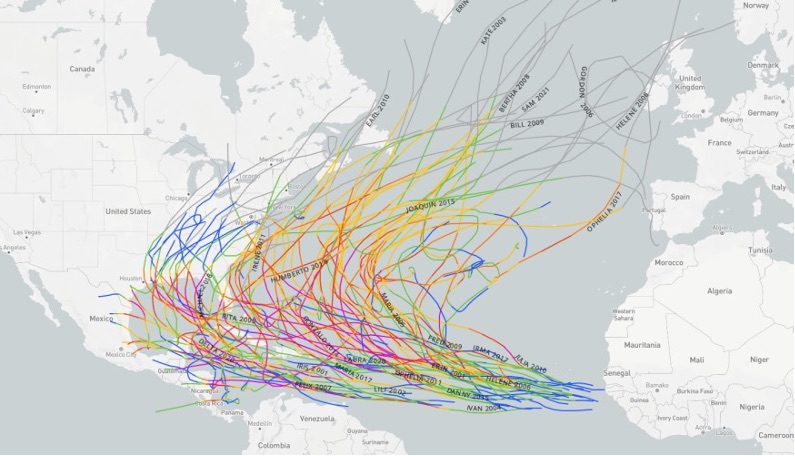
But in the Caribbean, the next shock often arrives before the previous one has been absorbed. Auffret (2003) showed that the Caribbean region experiences some of the highest consumption volatility in the world, which he links directly to its repeated exposure to disasters. And the mechanism feeds on itself: since incomes do not recover after a cyclone, as Hsiang and Jina point out, repeated shocks on the same territory pile losses up instead of erasing them. You do not converge towards a stable equilibrium when you are hit regularly before you have even finished rebuilding. The trajectory of these economies is not a quiet line occasionally disturbed: it is unstable by nature. That is a difference of kind, not of degree, and it is probably the deepest reason why the rebound story does not hold here.
Models built for another world
Here is the heart of the problem. The tools economists use to think about disasters were, for the most part, calibrated on large, diversified continental economies. A small island economy works differently, and the gap is not a technical detail.
Take a very concrete question: how does a hurricane turn into higher grocery prices in Guadeloupe? When most of what you consume is imported, a disruption to maritime supply passes almost directly into prices. Add to that a concentration of distribution channels, a specific indirect tax such as the octroi de mer (a duty levied on goods entering the territory), and dedicated price-regulation schemes. A model designed for a continental economy, with deep supply chains and multiple suppliers, simply does not see these channels. It is not wrong: it is calibrated for somewhere else. In the same way, many of these economies have only limited monetary sovereignty, which deprives them of stabilisation levers the models assume to be available.
And here at home: codes, prices, insurance
In the French territories of the Caribbean, where I live, a further layer is added. Some of the rules governing risk are designed in a mainland framework and then applied here, in principle with the same force. Anti-seismic and anti-cyclone building codes are the clearest example. On paper, they protect. In practice, their application runs into the reality of self-construction and insufficient compliance checks. The damage seen in Saint-Martin after Irma, on buildings that were in theory up to code, was a brutal reminder. The gap between the written norm and the applied norm becomes a source of vulnerability in itself.
The same question applies, at every level, to the schemes meant to protect us. Across the wider region, sovereign states pool their risk through the Caribbean Catastrophe Risk Insurance Facility (CCRIF), which pays out within days of an event, triggered not by a slow damage assessment but by parametric thresholds such as measured wind speed. For small states with little fiscal room, that speed is a genuine advance. But parametric design carries its own flaw, known as basis risk: the payout can fall short when a storm’s recorded intensity understates the real damage, or arrive when actual losses turn out to be limited. Does such a scheme truly reduce the budgetary volatility of its member states, or do its payouts drift too far from real losses? Closer to home, in the French territories, the same spirit of inquiry applies to the “Cat Nat” compensation regime: does it really protect overseas households, or does its mainland architecture create blind spots? And do price-regulation schemes such as the “Bouclier Qualité Prix” deliver on their promises? These are questions that bear directly on everyday life and on public budgets, and that we still evaluate far too rarely.
Turning the perspective around: the Caribbean as a starting point
Small island economies are often presented as special cases, exceptions set aside so as not to complicate the models. I propose the opposite. It is precisely because everything is concentrated there, the exposure to hazards, the structural constraints, the recurrence of shocks, that these territories reveal in plain sight what large economies only show in diffuse form. Where the gap between theory and reality is most visible, there is the most to learn.
And this relevance reaches beyond our shores. As climatic shocks intensify and recur elsewhere in the world, situations long confined to islands are becoming a shared horizon. What we live through today in the Caribbean foreshadows, in part, what other economies will discover tomorrow. Rethinking the economics of disasters from our island realities is therefore not a parochial retreat. It is a contribution to an entire field.
The challenge is no longer to prove that disasters matter. It is to understand how they shape our trajectories: who recovers, who falls behind, and why. This is the thread that runs through my doctoral work, and in the coming posts I will extend this reflection with two ideas that follow directly from it: why GDP measures the true cost of a disaster so poorly, and why the promise of a full recovery is largely a myth.
References
Auffret, P. (2003). High Consumption Volatility: The Impact of Natural Disasters? World Bank Policy Research Working Paper No. 2962.
Briguglio, L. (1995). Small Island Developing States and Their Economic Vulnerabilities. World Development, 23(9), 1615-1632.
Briguglio, L., & Galea, W. (2003). Updating and Augmenting the Economic Vulnerability Index. Occasional Paper, Islands and Small States Institute, University of Malta.
Hsiang, S. M., & Jina, A. S. (2014). The Causal Effect of Environmental Catastrophe on Long-Run Economic Growth: Evidence from 6,700 Cyclones. NBER Working Paper No. 20352.
Ouattara, B., & Strobl, E. (2013). The fiscal implications of hurricane strikes in the Caribbean. Ecological Economics, 85, 105-115.
Skidmore, M., & Toya, H. (2002). Do Natural Disasters Promote Long-Run Growth? Economic Inquiry, 40(4), 664-687.
Comments & reactions