August 26, 2026 · EN
The recovery myth: why an economy doesn't always return to normal
We tend to assume that after a disaster, sooner or later, everything returns to normal. But “returning to normal” is only one possible trajectory out of four. And the data suggest it is the exception, not the rule.
This is the third and final post in the series. In the first, I explained why the rebound story does not hold for our islands; in the second, why GDP measures the true cost of a disaster so poorly. That leaves the deepest question, the one that links the two: after the shock, does an economy really return to its original trajectory? Economists have mapped four possible answers. Only one matches the idea we spontaneously have of recovery.
Four possible trajectories
Synthesised by Hsiang and Jina, four long-run trajectories describe what can happen to a country’s income per capita after a disaster.
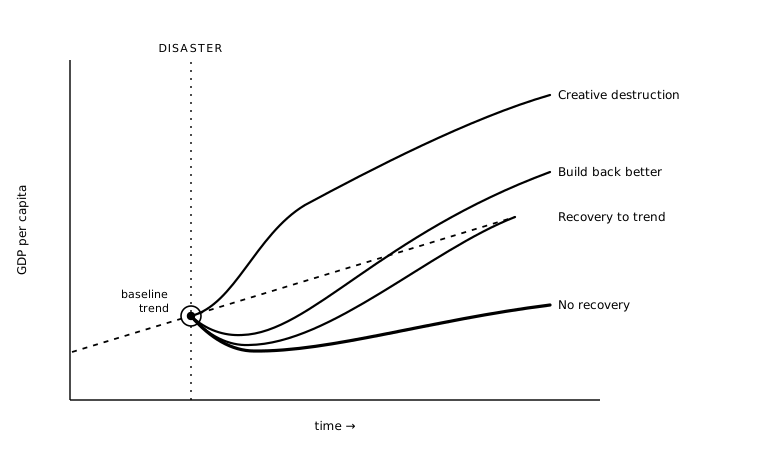
The first is creative destruction. By destroying ageing or unproductive capital, the disaster would free up room for newer, more efficient investment. The market recomposes itself, and the economy ends up above its previous trajectory.
The second is build back better. The same outcome, an economy that ends up above its earlier level, but by a different route: an ambitious reconstruction, funded by the public purse or international aid, that replaces the old with something more resilient and more productive. Here the overshoot comes from a deliberate choice, not a spontaneous market adjustment.
The third is recovery to trend. The disaster causes a slowdown, then the economy converges back to its initial trajectory. This is the picture most of us have in mind when we talk about “recovery,” and it is, as we will see, the textbook prediction.
The fourth is no recovery. The economy never returns. It settles durably onto a lower path than the one it would have followed without the shock.
These four scenarios are not rival theories: they are the bounds of a single spectrum. Which trajectory materialises depends on the type of shock, the level of development, the depth of financial markets, and the quality of institutions, that is, the state’s capacity to coordinate reconstruction, the reliability of compensation and insurance schemes, and the effectiveness of the administration that runs them.
What the textbook predicts
Let’s start with the scenario that standard theory treats as the most natural: recovery to trend. In the growth model inherited from Solow, a disaster is only a shock to the capital stock.
The return mechanism rests on a simple property: the better equipped an economy already is, the less an additional piece of equipment earns it. One more factory in a country that has a thousand changes little; the same factory in a country that has just lost half of them becomes immediately valuable. Economists call this the diminishing returns to capital. By destroying equipment, the disaster therefore makes every euro invested to replace it more profitable. Investment flows in, you rebuild, and the economy climbs back mechanically towards its earlier path. Recovery here is automatic, almost guaranteed.
But this mechanism rests on demanding assumptions: functioning markets, accessible credit, frictionless capital reallocation. In this world, the disaster touches neither savings, nor technology, nor institutions. It merely shifts the economy temporarily along a return path that is already mapped out. It is coherent and reassuring. It is also, as so often, where the trouble begins.
What the data say
Confronted with the facts, this promise wavers. For a long time, though, the literature tended to support the optimism: the founding study by Albala-Bertrand (1993), built on six Latin American disasters, concluded that capital loss is unlikely to affect growth strongly, and that even a moderate public response can be enough to prevent a downturn. We were then on the side of recovery to trend, or even build back better.
But the most ambitious study on the subject overturned that conclusion. Drawing on more than 6,700 cyclones, Hsiang and Jina (2014) explicitly reject the three optimistic scenarios, creative destruction, build back better and recovery to trend. National income falls away from its prior trend and does not rejoin it within the following twenty years.
And the mechanism they describe explains why the myth survives so well. The loss does not take the form of a spectacular collapse followed by a climb back. It takes the form of a slight dampening of the annual growth rate, sustained over some fifteen years. Taken year by year, the difference is almost imperceptible; accumulated, it becomes considerable. A cyclone among the most intense 10% thus lowers income per capita by 7.4% two decades later, the equivalent of 3.7 years of development wiped out. The authors stress the point themselves: these gradual losses go unnoticed. An economy that bounces back is visible; an economy that drifts slowly downward, never returning, looks deceptively like one that is convalescing. That is why we go on believing in the rebound.
Among the four trajectories, then, it is no recovery that best describes what many economies live through. And above all, recovery to trend, which standard theory treats as the normal case, turns out in practice to be one of the rarest. What the textbook presented as the rule becomes an exception.
Should we conclude that recovery never happens? No, and this is where the picture becomes more nuanced. Part of the disagreement, in fact, comes down to the horizon considered: Albala-Bertrand observed immediate effects, whereas Hsiang and Jina track an erosion that unfolds over two decades. Both can be right at once, and that is exactly what makes the phenomenon so hard to see. Beyond that, Skidmore and Toya (2002) found that climatic disasters could even be associated with stronger growth, through human capital accumulation and productivity gains, which this time matches the creative-destruction scenario. The survey of this literature by Cavallo and Noy (2011) confirms that no single verdict prevails: the long-run effect depends on a country’s conditions, starting with the quality of its institutions. The lesson, then, is not that an outcome is written in advance, but that the trajectory depends on the type of shock and on a country’s conditions far more than on any automatic mechanism of convergence.
Why the rebound doesn’t kick in
If recovery to trend is not the norm, it is because the conditions for an automatic rebound are rarely met. The textbook assumes that investment floods in to rebuild the destroyed capital. But that inflow depends on a financial system able to channel money towards its most productive uses. When banks ration credit, when insurance is lacking, the theoretical rise in investment fails to materialise. Mendoza (2010), studying financial crises, showed how this kind of credit constraint turns a temporary shock into a deep and lasting recession: starved of financing, activity contracts instead of rebounding.
There is also a channel the standard model ignores: a disaster destroys more than walls. It destroys human capital, interrupts schooling, breaks up networks of skills and innovation. And that loss is offset by no rise in the return on capital: it bends the trajectory durably. And then there is recurrence, which I discussed in the first post: when the next shock arrives before reconstruction is finished, the economy never has time to converge. The persistence of losses, then, is no mystery. It is what we should expect once the conditions for a rebound are missing.
Recovery is not decreed, it is built
The myth, at bottom, is not believing that an economy can recover. It is believing that it does so on its own. The four trajectories are not a lottery: which one materialises depends on financing capacity, on institutions, on the type of shock, and, as I showed in the previous post, on resilience, that capacity to spread and absorb the loss. The only favourable scenario that owes nothing to chance, build back better, is precisely the one that results from a deliberate choice.
This is where the loop closes. If recovery is built rather than simply happening, then the levers raised throughout this series, social protection, financial inclusion, more resilient reconstruction, are not options among others: they are what tips an economy from no recovery towards build back better. And this is why the Caribbean, where I began, is not a marginal case: it is where the gap between the myth and reality is most visible, and where building recovery matters most.
That leaves the big open question, the one that guides my doctoral work: to understand precisely which mechanisms tip an economy from one scenario towards another. It is by answering it that we will stop promising recoveries that never come.
References
Albala-Bertrand, J. M. (1993). Natural Disaster Situations and Growth: A Macroeconomic Model for Sudden Disaster Impacts. World Development, 21(9), 1417-1434.
Cavallo, E., & Noy, I. (2011). Natural Disasters and the Economy: A Survey. International Review of Environmental and Resource Economics, 5(1), 63-102.
Hsiang, S. M., & Jina, A. S. (2014). The Causal Effect of Environmental Catastrophe on Long-Run Economic Growth: Evidence from 6,700 Cyclones. NBER Working Paper No. 20352.
Mendoza, E. G. (2010). Sudden Stops, Financial Crises, and Leverage. American Economic Review, 100(5), 1941-1966.
Skidmore, M., & Toya, H. (2002). Do Natural Disasters Promote Long-Run Growth? Economic Inquiry, 40(4), 664-687.
Comments & reactions